Common species in Pennsylvania
Pennsylvania follows the state health led source pattern. The species below are drawn from the state-authority sources listed in the sidebar Data Row.
- Brown dog tick (dog/kennel context)
- Groundhog tick (Ixodes cookei — Powassan vector context)
- Asian longhorned tick (PA Dept of Ag + PA DEP surveillance — established in multiple PA counties)
- Lone star tick (continuing northward + central PA expansion documented by PA DOH)
When ticks are most active
Broad caution April through October. Blacklegged tick nymphs peak May-July; adult blacklegged active spring + fall and can move on warm winter days (Pennsylvania consistently leads U.S. Lyme case counts most years). Lone star tick activity May-August expanding northward. American dog tick spring + early summer.
Where you're most likely to encounter ticks
Pocono Mountains hiking, Allegheny National Forest, Pittsburgh + Philadelphia suburban edges, Lancaster + Berks County farmland, Susquehanna River valley trails, Penn State + State College area, Gettysburg + South Mountain hiking, Erie + Lake region trails, hunting properties statewide, dog walking in any wooded edge.
Disease context
Each disease named below carries an evidence tag per the Data Row policy. Pills indicate the strength of state-specific evidence, not the severity of the disease. Symptoms should always be routed to a clinician; this is orientation, not diagnosis.
- Lyme diseasestate surveillance confirmed
Pennsylvania consistently reports the highest absolute Lyme case count among U.S. states most years; PA DOH publishes county-level surveillance
- Anaplasmosisstate surveillance confirmed
- Babesiosisstate surveillance confirmed
- Powassan virus diseasestate surveillance confirmed
- Ehrlichiosisstate surveillance confirmed
- Hard tick relapsing feverstate surveillance confirmed
- Alpha-gal syndromeregional pattern
Lone star expansion makes PA a watch zone for AGS; documented PA cases
- Rocky Mountain spotted fevernon diagnostic mention only
- Tularemianon diagnostic mention only
If you find a tick — what to do
Map resolution notes
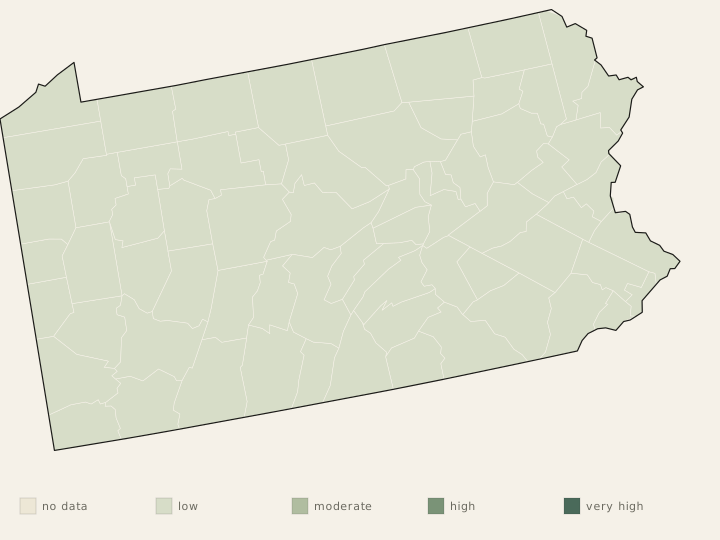
mixed resolution.PA DOH publishes county-level Lyme + tickborne disease surveillance — that data supports county-resolution claims, especially in the high-incidence eastern + central PA counties. Penn State Tick Surveillance Project publishes life-stage and habitat-resolution data. CDC maps support national comparison.
State sources
- Primary species source
- Pennsylvania Department of Health (PA DOH) Tick-Borne Diseases hub and PA DOH species + distribution pages; Penn State Extension publications on Pennsylvania tick species and life cycle nuance.
- Primary health source
- PA DOH Tick-Borne Diseases hub, PA DOH Lyme + anaplasmosis + babesiosis + Powassan surveillance reports, and PA DOH clinician guidance; CDC pages and maps for national guardrails.
- Primary extension source
- Penn State Extension (Pennsylvania State University) publications on ticks, tick-borne diseases, yard/property tick management, and PA-specific blacklegged tick biology.
- Surveillance
- PA DOH county-level Lyme + tickborne disease surveillance; PA Dept of Agriculture for animal-health + Asian longhorned tick watch; Penn State Tick Research Lab + the Pennsylvania Tick Surveillance Project (PA DEH-funded) for high-resolution county + life-stage surveillance; CDC for national comparison.