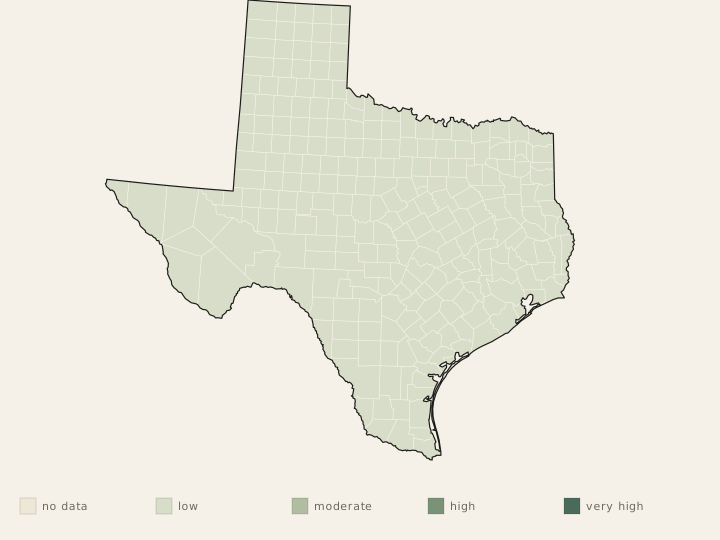
Common species in Texas
Texas follows the split authority source pattern. The species below are drawn from the state-authority sources listed in the sidebar Data Row.
- Gulf Coast tick (coastal + eastern Texas)
- Blacklegged tick (limited eastern + piney woods presence)
- Asian longhorned tick (TAHC + USDA APHIS watch context; not yet established in Texas as of latest surveillance)
- Cayenne tick (Amblyomma cajennense complex — South Texas / border surveillance context)
When ticks are most active
Long active window — most of the year in much of Texas. Lone star + American dog tick activity peaks April through August across most of the state; brown dog tick can persist year-round indoors and in kennels. Coastal + South Texas can see activity in mild winters. Eastern Piney Woods follow the regional pattern; West Texas is lower-burden but not zero.
Where you're most likely to encounter ticks
Hill Country hiking, East Texas Piney Woods + Big Thicket, Gulf Coast beaches and barrier islands, South Texas brush country and ranching land, Hunt camps and deer leases statewide, North Texas suburban edges (DFW), Austin greenbelts, San Antonio + Hill Country state parks, Big Bend and West Texas trails (lower burden but not zero), kennel/working-dog environments where brown dog tick can establish.
Disease context
Each disease named below carries an evidence tag per the Data Row policy. Pills indicate the strength of state-specific evidence, not the severity of the disease. Symptoms should always be routed to a clinician; this is orientation, not diagnosis.
- Rocky Mountain spotted feverstate surveillance confirmed
Texas DSHS reports RMSF; brown dog tick is the primary vector in South Texas RMSF clusters
- Alpha-gal syndromestate unique angle
Lone star tick is the primary U.S. AGS vector and is dominant in Texas — Texas is a major watch state for AGS
- Ehrlichiosisstate surveillance confirmed
- STARI (Southern Tick-Associated Rash Illness)regional pattern
Lone star tick territory; clinically presents like Lyme but cause is undefined
- Tularemiastate surveillance confirmed
- Tickborne relapsing feverstate surveillance confirmed
Soft-tick TBRF documented in Texas; distinct from hard-tick relapsing fever
- Heartland virusnon diagnostic mention only
Lone star tick is the vector; cases reported in nearby states
- Bourbon virusnon diagnostic mention only
- Lyme diseasenon diagnostic mention only
Not a Texas lead frame; reported cases are low and often travel-associated. Route through DSHS guidance, not Lyme-corridor framing.
If you find a tick — what to do
Map resolution notes
mixed resolution.DSHS publishes county-level case data for several tickborne diseases; that data supports county-resolution disease claims (especially RMSF in South Texas). Cattle fever tick eradication zones (USDA APHIS) define very specific border-county surveillance. Texas A&M AgriLife covers regional + ecoregion-scale species claims (Piney Woods, Edwards Plateau, South Texas Plains, etc.). CDC maps support national comparison. Do not infer fine-grained risk in non-cited counties — Texas is large enough that ecoregion matters.
State sources
- Primary species source
- Texas Department of State Health Services (DSHS) Tick-Borne Diseases hub; Texas Parks & Wildlife Department field references for habitat + wildlife context; Texas A&M AgriLife Extension for tick biology + species ID nuance.
- Primary health source
- Texas DSHS Tick-Borne Diseases hub, DSHS RMSF + ehrlichiosis + tularemia + TBRF surveillance reports, and DSHS clinician guidance; CDC pages and maps for national guardrails.
- Primary extension source
- Texas A&M AgriLife Extension Service publications on ticks, lone star tick + alpha-gal syndrome, and brown dog tick / RMSF context.
- Surveillance
- Texas DSHS tickborne disease surveillance + epidemiology reports; Texas Animal Health Commission (TAHC) for animal-health surveillance + Asian longhorned tick watch; USDA APHIS for cattle fever tick (Rhipicephalus annulatus/microplus) eradication zone context along the Mexico border; CDC for national comparison.