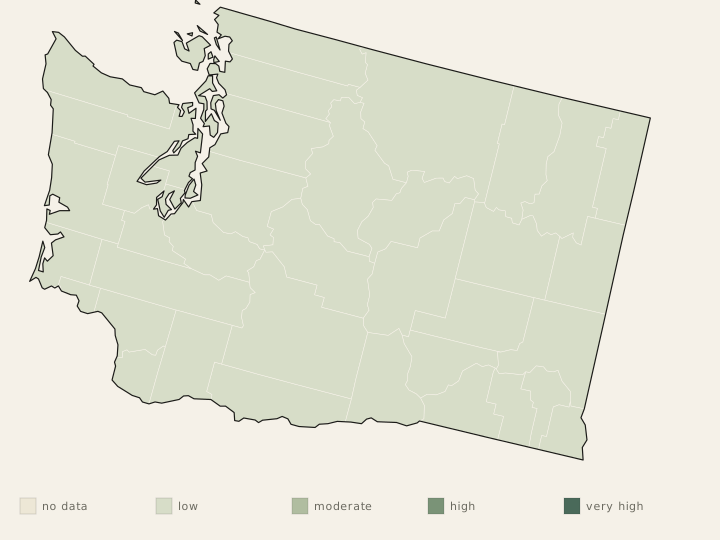
Common species in Washington
Washington follows the state health led source pattern. The species below are drawn from the state-authority sources listed in the sidebar Data Row.
- Pacific Coast tick (limited southern WA presence)
- Brown dog tick (dog/kennel context)
- Asian longhorned tick (WSDA + DOH watch context; not yet established as of latest reports)
When ticks are most active
Wet-spring + dry-summer pattern. Rocky Mountain wood tick adults peak February-June east of the Cascades; western blacklegged adults peak November-May (wet season) west of the Cascades; American dog tick spring-summer. Eastern + central WA (drier shrub-steppe) is the higher RMSF + Colorado tick fever zone; western WA (wet forests) is the western blacklegged Lyme zone — same state, very different risks.
Where you're most likely to encounter ticks
Olympic Peninsula + Olympic National Park hiking, Mount Rainier + Cascades trails, Methow + Okanogan + eastern WA shrub-steppe (Rocky Mountain wood tick country), San Juan Islands, Seattle + Puget Sound suburban edges, Spokane + Inland Northwest hiking, Columbia Gorge, hunting + ranching properties east of the Cascades, dog walking in wooded edges west of the Cascades.
Disease context
Each disease named below carries an evidence tag per the Data Row policy. Pills indicate the strength of state-specific evidence, not the severity of the disease. Symptoms should always be routed to a clinician; this is orientation, not diagnosis.
- Rocky Mountain spotted feverstate surveillance confirmed
Eastern WA Rocky Mountain wood tick territory; DOH publishes RMSF surveillance
- Colorado tick feverstate unique angle
Eastern + central WA Rocky Mountain wood tick territory — Colorado tick fever is regionally relevant
- Tularemiastate surveillance confirmed
- Lyme diseasestate surveillance confirmed
Western WA western blacklegged tick territory; lower incidence than Northeast but present
- Anaplasmosisstate surveillance confirmed
- Tickborne relapsing feverstate surveillance confirmed
Soft-tick TBRF documented in WA mountain cabins + rodent-infested structures
- Babesiosisnon diagnostic mention only
- Ehrlichiosisnon diagnostic mention only
If you find a tick — what to do
Map resolution notes
mixed resolution.WA DOH publishes county-level tickborne disease data. The Cascades-divide is the most important framing — eastern WA and western WA have meaningfully different tick species + disease profiles. Don't generalize a single statewide risk. WSU Extension covers ecoregion-resolution claims. CDC maps support national comparison.
State sources
- Primary species source
- Washington State Department of Health (DOH) Zoonotic Diseases + Ticks hub; Washington State University (WSU) Extension entomology publications; WSU Department of Entomology.
- Primary health source
- WA DOH Zoonotic Diseases tickborne disease surveillance + clinician guidance; CDC pages and maps for national guardrails.
- Primary extension source
- WSU Extension publications on WA tick species (notably the east-of-Cascades Rocky Mountain wood tick vs west-of-Cascades western blacklegged) and yard/property tick management.
- Surveillance
- WA DOH county-level tickborne disease surveillance; Washington State Department of Agriculture (WSDA) animal-health + Asian longhorned tick monitoring; WSU Entomology; CDC for national comparison.